Open source / Workflow automation

n8n
Tried by the authorA node-based workflow automation platform that chains app APIs, webhooks, schedules and AI steps into automated flows. Source-available (fair-code) rather than OSI open source, with a free self-hosted Community edition.
Pricing: Self-hosted Community is free for internal use. Business costs €667 a month with 40,000 monthly workflow executions (the Startup Plan halves self-hosted Business to about €333.50 a month for companies under 20 staff). Cloud Starter and Pro cost €20 and €50 a month. All listed paid rates are billed annually. Prices checked November 19, 2026.
Does it fit your team?
- Consider it if
- You want to automate internal workflows across APIs, webhooks, schedules and AI steps, and you can run a server with at least 2 vCPUs and 4 GB of RAM.
- Look elsewhere if
- Hosting n8n for others, white-labeling it, or letting clients configure their own workflows requires a commercial license. Self-hosted Business adds workflow sharing, SSO and Git at €667 per month billed annually.
- Can you use it commercially?
- Internal business use only; no paid hosting or resale
The Sustainable Use License 1.0 covers the core, with a separate Enterprise license for .ee code. An agency may build and run workflows on its own instance for clients. Clients can receive outputs or connect their accounts while the agency alone edits the workflow logic. A commercial license is required when external clients can configure workflows through any interface, API, or agent, or when the agency offers hosting or white-labels n8n. Keep copyright notices intact.
- Is it still maintained?
- Active
Last push on 2026-11-19. The repository is not archived.
- How hard is it to deploy?
- Moderate
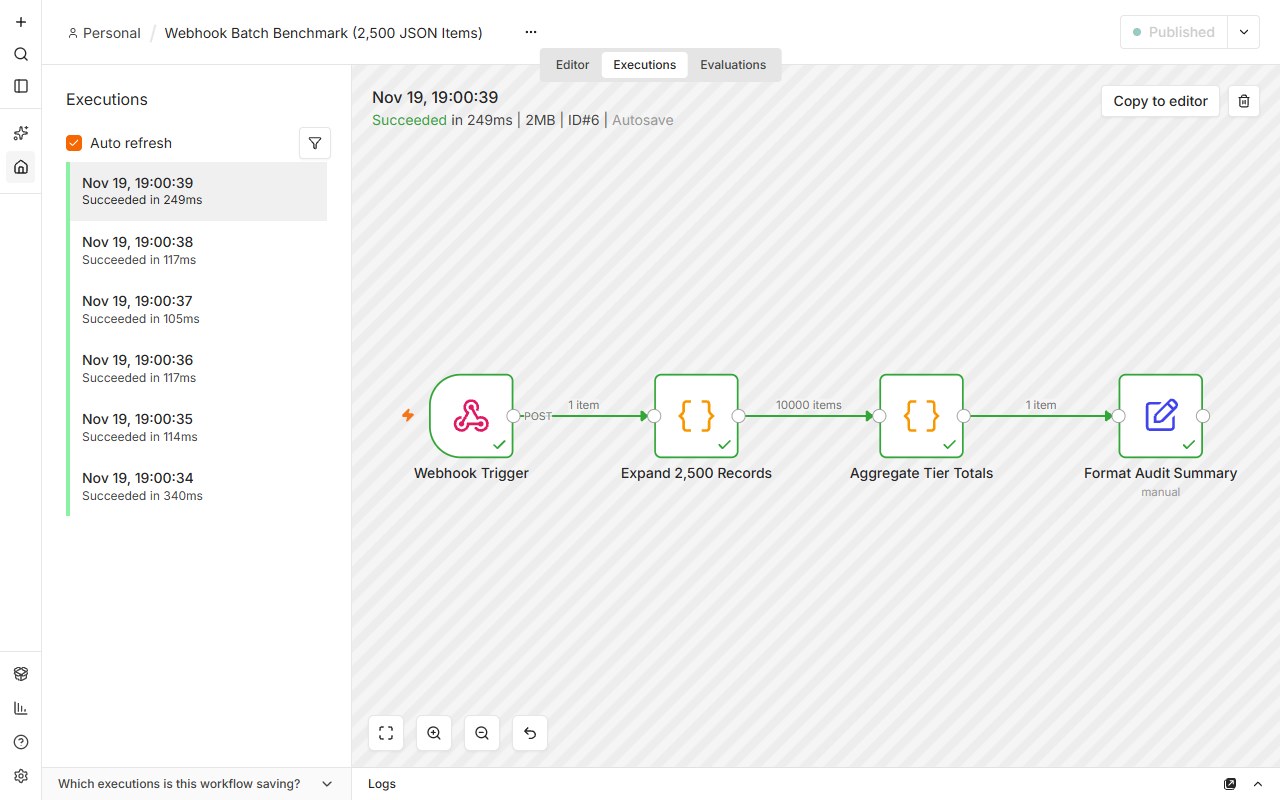
A single Docker command starts n8nio/n8n on port 5678 using SQLite by default. For production, official Docker Compose templates pair it with PostgreSQL behind a reverse proxy and HTTPS. The official Docker Compose guide lists 2 vCPUs and 4 GB of RAM for a stack that includes the AI Assistant sandbox-runner-1 Docker-in-Docker container (dev/test); even without it we still recommend 4 GB in production for Node.js + Postgres + Queue Mode headroom. In our 2026-11-19 hands-on run of n8n 2.35.0 (released 2026-08-11; newer 2.48.x stable releases exist as of Nov 2026) on a local Windows host (Node.js v22.23.1 + internal JS Task Runner, Windows memory counters), idle working set sat at 395 MB before any database or reverse proxy and rose to 491 MB (+96 MB) after six webhook batches totaling 22,500 JSON items; on the private-commit counter the same climb was 413 → 505 MB (+92 MB). SQLite grew to 5.3 MB.
Docker Compose guideDocker guideDocker Compose with Postgres
- What does it cost?
- Free Community edition. Business is €667/month billed annually
Self-hosting Community is free with unlimited workflows, executions and users; we recommend at least 2 vCPUs and 4 GB of RAM in production. The official euro prices checked on November 19, 2026 were €667 per month for self-hosted Business (under 100 employees, 40,000 monthly workflow executions) — companies under 20 staff can apply for the Startup Plan at 50% off self-hosted Business (about €333.50/month) — and €20 or €50 per month for Cloud Starter and Pro (2,500 or 10,000 monthly executions). Those rates are billed annually. Enterprise is quoted separately. Note that S3/external binary storage is a paid-license feature; Community Queue Mode should keep the default database binary storage or a shared NFS volume.
PricingDocker Compose guideExternal binary storageQueue mode
- What to watch out for
- Community omits workflow sharing, SSO and Git version control
According to the official Community edition feature list, Community leaves out Projects and workflow or credential sharing: only the instance owner and the person who created a workflow or credential can access it. SSO (SAML / LDAP), environments, Git version control and custom variables require paid Business (€667/mo annual); external secrets, log streaming and multi-main high availability are Enterprise-only (contact sales; queue mode with workers is included in Community). Folders, debug data pinning and custom execution data are free, but require registering an email address for a free Community license key.
The author has run this project. The points above are based on the license text, commit history and official docs. Last checked: . · How we verify & commercial disclosure
If your priority is different
 ActivepiecesMIT-core workflow and AI automation builder with TypeScript pieces, positioned as a lower-cost team alternative to Zapier and n8n ($200/mo Team, capped at 50,000 credits/mo).Commercial useMIT coreSetupModerate
 WindmillDeveloper-first workflow engine and internal app platform that turns Python, TypeScript, Go, Bash and SQL scripts into production flows and UIs.Commercial useAGPL + proprietarySetupModerate
Track license switches, Enterprise paywall jumps & new RAM benchmarks
One primary-source dispatch per month via Substack or RSS. Direct diffs of changed vendor terms, newly gated ee/ directories, and real infrastructure crossover math. Zero spam, zero paid placements.
Your industry is not here?
Tell me the industry and what you need solved. I will look at it next.